
Creative t-shirt art fails if it isn’t sharp and properly formatted. Uploading JPG or PNG files often results in blurry prints because raster images rely on pixels that degrade when resized.
Vector files use mathematical paths instead of pixels, allowing for infinite scaling without losing clarity. This makes them essential for crisp, professional prints at any size. Using a professional vector tracing service ensures your design is print-ready without the need to master complex software.
2. What Are Vector Files?
Definition and Structure
Vectors use paths and mathematical formulas rather than pixels. This keeps images perfectly sharp and smooth at any size. They are the go-to choice for logos and professional printing.
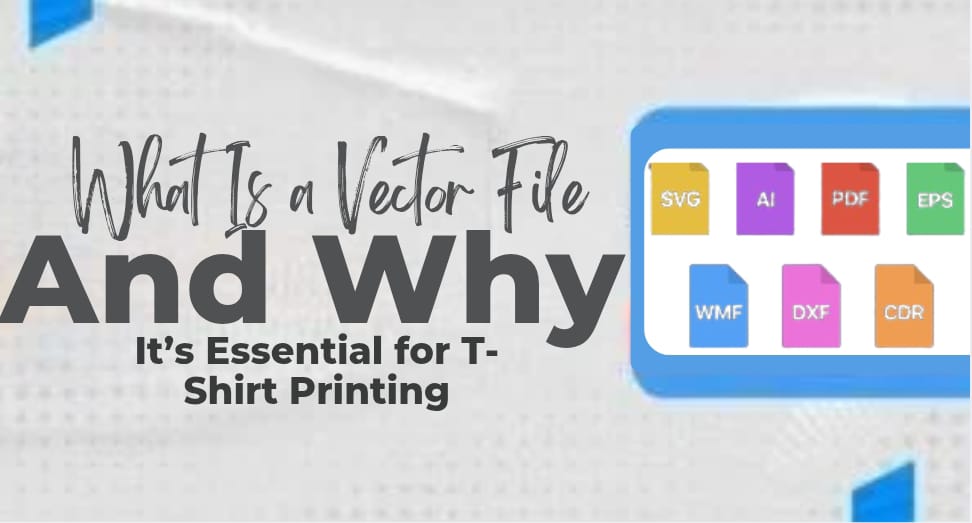
Common Vector Formats
Pros use AI, EPS, SVG, PDF, and CDR. These formats maintain clean edges and are easy to edit.
Vector vs. Raster
Raster images (JPG, PNG) are made of pixels that blur when stretched. While a small JPG might look okay on a screen, it will look fuzzy on a shirt. Vectors stay crisp regardless of scale.
Why Printers Need Vectors
Screen printing relies on precise paths for ink application. Vector files provide exact data for clean colour separation and sharp edges. They are the foundation of high-quality apparel prints.
3. Why Vectors Are Essential for T-Shirt Printing
I. Essential Benefits of Vector Files for High-End Production
Vector graphics use mathematical paths rather than pixels, enabling infinite scalability. A single file ensures perfectly crisp lines at any size, from small emblems to large graphics, without blurring or pixelation.
Streamlined Colour Separation for Screen Printing: Screen printing requires a separate screen for each color. Vector artwork’s organized layers enable fast, precise color separation, minimizing ink overlap and misregistration.
Machine-Level Compatibility: Screen printing machines follow geometric vector paths rather than pixels. This ensures precise ink placement, smooth curves, and sharp edges across large production runs.
Long-Term Versatility and Ease of Modification: Vectors provide permanent, editable assets. Distinct elements allow instant adjustment of text, colors, or shapes without redesigning. This flexibility lets you repurpose high-quality art for any product, from apparel to oversized banners.
II. Critical Failures Associated with Non-Vector (Raster) Artwork
Degradation and the “Jagged Edge” Effect: The most common pitfall of raster-based artwork is the loss of quality during enlargement. When a JPG or PNG is stretched to fit a garment, the software must “interpolate” or guess where to add more pixels. The result is a blurred, jagged, or “staircase” effect on what should be clean lines. This looks unprofessional and significantly lowers the perceived value of the merchandise.
Raster files lack defined boundaries, causing colour bleeding, muddy tones, and uneven ink distribution. They make precise shade matching difficult for printers.
Financial Waste and Production Bottlenecks: Low-quality artwork is a primary driver of increased production costs. Print shops often have to spend hours cleaning up “dirty” files or manually recreating them, leading to unnecessary labour fees and project delays. Furthermore, poor artwork poses a high risk of ruined garments; if the registration is off or the lines are too thin to hold ink, entire batches of shirts can be rendered unsellable due to alignment issues and ink bleeding.
III. The Strategic Advantage of Professional Vector Tracing
Efficiency and Guaranteed Acceptance: Hiring a professional service like 1dollar Digitizing ensures that your files meet strict industry standards on the first attempt. Professional shops often reject low-resolution files to protect their own quality reputation. By providing a pro-grade vector file, you bypass the back-and-forth revisions and move straight into the production phase, saving valuable time and avoiding frustration.
Expert Machine Logic and Design Flow: Professional digitizers don’t just “trace”; they understand the physics of the printing and embroidery processes. They optimize line thickness for different fabrics and ensure that path directions are balanced for the specific machine being used. This expert touch ensures that the final physical product—whether stitched or printed—is a perfect replica of the original digital vision.
Long-Term Cost-Effectiveness: While there is a small upfront investment, professional tracing pays for itself by preventing expensive reprints and wasted materials. A single, perfectly executed vector file can be used for years, protecting your bottom line from the hidden costs of “cheap” or amateur artwork.
Speed and Quality Guarantees: 1dollar digitizing services offer incredible turnaround times, often delivering a finished product within 2 to 4 hours. With rates starting as low as $1 and the inclusion of unlimited free edits, it is far more efficient to outsource the technical labour to experts than to struggle with complex software yourself.
IV. The Professional Conversion Process: A Step-by-Step Breakdown
Image Evaluation: The team analyses the reference image, regardless of its initial quality, to identify core shapes and intended proportions.
Manual Hand-Tracing: Professionals avoid “Auto-Trace” buttons, which often create messy, inaccurate paths. Instead, they manually redraw every line using software like Adobe Illustrator or CorelDRAW to ensure total accuracy.
Refining Anchor Points: Every geometric point is adjusted and smoothed to ensure a natural, balanced flow, resulting in perfect symmetry and surgical edges.
Strategic Colour Layering: Each colour is isolated onto its own layer, specifically formatted for the screen printer’s needs to ensure zero overlap.
Output in Industry Formats: The final art is saved in professional formats like AI, EPS, or PDF, ensuring it is ready for any machine in the world.
Final Quality Audit: A human expert checks the file for registration marks, hidden pixels, and alignment to ensure the visual harmony and proportions of the original art are preserved.
Conclusion
In the competitive world of apparel, your brand is only as good as your print quality. Vector files are the technical backbone of every successful t-shirt line. By prioritizing clean, professional vector tracing, you eliminate the risks of dull, blurry prints and instead deliver vibrant, long-lasting products. Don’t risk your reputation on low-quality files; let the experts handle the technical conversion so you can focus on the creative growth of your business.